Key Takeaways
"Compostable" doesn't mean one thing. Home compostable and commercially compostable packaging require completely different conditions to break down and sending the wrong one to the wrong place actually defeats the purpose of these products.
Most compostable packaging requires a commercial facility. Only about 35.9% of the U.S. population currently has access to composting programs, up from just 27% in 2020.
Certifications are your guide. Look for a BPI certified compostable, ASTM D6400/D6868, or OK Compost HOME to know what you're actually buying and where it should belong at the end of its life.
If commercial compostable packaging can't reach a facility, it won't perform as labeled. When operators buy industrially compostable packaging without access to a composting facility, the product may go to a landfill, performing no differently than conventional plastic. The cost premium paid delivers no environmental benefit.
Home Compostable vs. Commercially Compostable: What the Label Actually Means
Most products simply labeled "compostable" require industrial conditions to decompose, meaning they won't break down properly in your home compost bin. That single fact is the root of most of the confusion around compostable packaging labels.
Compostable packaging is designed to return to the earth as nutrient-rich material, but can only do so under the right conditions. Those conditions vary significantly depending on the type of certification a product carries.
Home Compostable Packaging: What It Is and How It Works
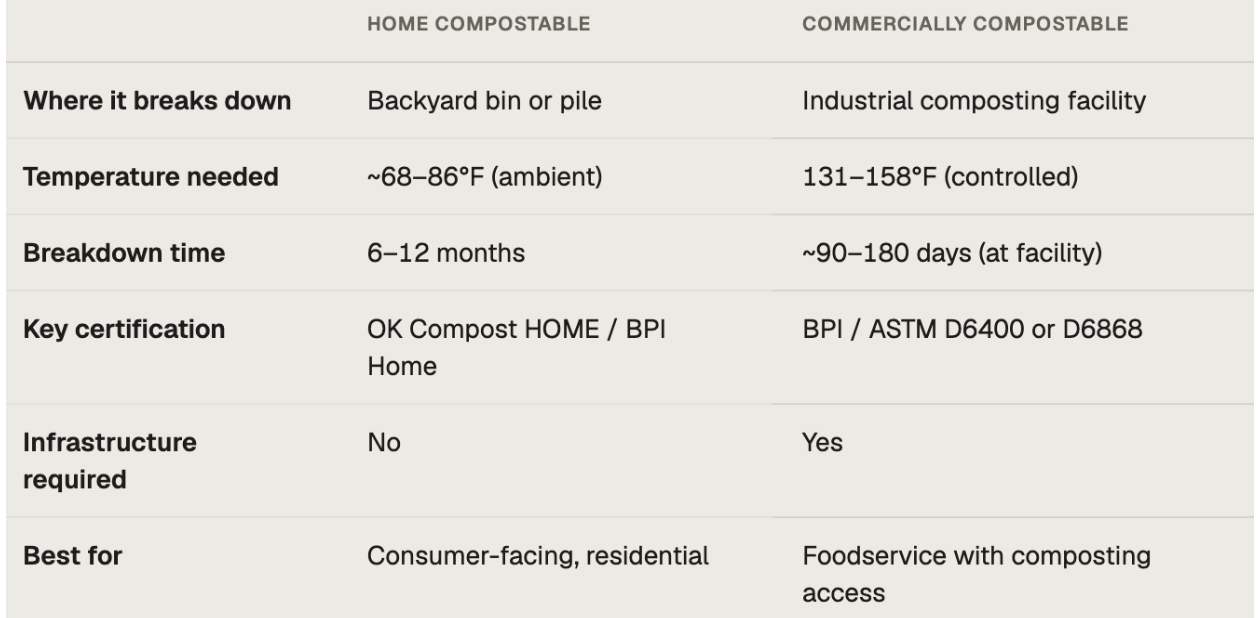
The key difference between home compostable and industrial compostable packaging lies in where and how the material breaks down. Home compostable packaging decomposes in garden compost bins under ambient conditions, without the need for high heat, making it suitable for disposal in a standard backyard bin.
Home compostable products are made to break down in about 6 to 12 months, depending on the overall conditions in the home compost pile, including temperature, moisture, and airflow. While a slower, more variable process, it has a major advantage: it works without any special infrastructure.
Home compost piles typically operate around 68-86°F, compared to 136°F in commercial composting systems. This lower temperature means home compostable products are specifically engineered to break down under these gentler, less controlled conditions.
What to Look For on the Label
The leading certification for home compostable packaging is OK Compost HOME, issued by TÜV Austria. In 2025, BPI also launched its Commercial & Home Compostable Certification program, allowing products to carry a single label for both environments. If a product carries either of these marks, it's verified to break down in a backyard or bin composting setting - no facility required.
Home compostable is often the right choice for:
Businesses whose customers compost at home
Direct-to-consumer brands where end-of-life conditions vary
Operations in areas without nearby commercial composting infrastructure
What Does Commercially Compostable Mean?
Materials labeled as "commercially compostable" require the specific conditions found in industrial composting facilities to break down properly. These facilities maintain higher and more controlled temperatures (usually between 131–160°F).
Industrial compostable packaging requires the high heat and controlled environment of commercial composting facilities to break down properly. While it can also go into food waste bins, this is only effective where appropriate composting infrastructure is available.
Commercially compostable products are the most common type you'll encounter in foodservice - cups, clamshells, cutlery, and containers. The trade-off is that they depend entirely on the availability of a qualifying composting facility to deliver on their end-of-life promise.
What to Look For on the Label
The gold standard in North America is BPI (Biodegradable Products Institute) certification. BPI-certified products meet ASTM D6400 or D6868 testing standards to certify they will break down in a managed compost facility.
Think of it this way: ASTM wrote the exam. BPI is the proctor that grades it and issues the diploma. A product can be tested to ASTM D6400 criteria in a lab, but without third-party certification from an organization like BPI, there's no independent verification that it actually passed.
There are two relevant ASTM standards to know:
ASTM D6400 - applies to compostable plastics and plastic products
ASTM D6868 - applies to compostable packaging materials that combine bioplastics with other substrates like paper or fiber
Municipalities and commercial composting facilities increasingly require BPI certification vs. just a claim of ASTM compliance. If you're in a jurisdiction with organic waste mandates, your compostable packaging often needs the BPI logo to be accepted in these commercial streams.
Commercially compostable is often the right choice for:
Restaurants, cafes, and food trucks with access to a composting program
Event venues and stadiums with organized compost collection
Businesses in states like California, New York, and Oregon with strong composting infrastructure
The Infrastructure Gap & And Why It Matters
Here's the real-world challenge: of roughly 170 full-scale composting facilities nationwide, only 46 accept compostable packaging. Ten states have no industrial composting facilities and another twenty have only one to three.
Access has increased by 8.9 percentage points since 2020, which marks real progress, but it also means that for most of the country, commercially compostable packaging sent to the bin without a facility to receive it won't break down as intended. Landfills are designed for long-term storage of waste, not efficient decomposition. Composting needs specific conditions to break down properly and these conditions are carefully maintained in composting facilities, not in landfills.
The environmental value of commercially compostable packaging is directly tied to access to the right disposal path.
What Happens If Commercially Compostable Packaging Ends Up in a Landfill?
If a product is certified as industrially compostable and there are no industrial compost facilities available, the last option is regular waste. Landfills are designed to hold waste and prevent or delay its decomposition. Compostable products sent to landfills will remain there without measurable degradation.
A Quick Comparison: Home vs. Commercially Compostable
How to Choose the Right One for Your Business
Step 1: Confirm your disposal access. Use tools like Find a Composter to see what's available in your area before purchasing.
Step 2: Match the product to the path. If your customers, guests, or staff don't have access to a commercial composting facility, home compostable products will deliver more reliable results.
Step 3: Look for verified certifications. Don't rely on vague "eco-friendly" or "green" claims. Look for the BPI logo, CMA Logo, OK Compost HOME mark, or a specific ASTM standard on the product or its packaging.
Step 4: Communicate clearly with your team. Even the best compostable packaging fails if it's sorted into the wrong bin. Clear bin labeling significantly improves correct disposal.
The Bottom Line
Home compostable and commercially compostable packaging both serve important roles in reducing single-use waste. However, they aren't interchangeable and treating them as if they are undermines the very outcome you're trying to achieve.
The label tells you what the material can do. Your local composting infrastructure determines what it will do.
That distinction matters more than most buyers realize at the point of purchase. A foodservice operator in San Francisco with curbside composting pickup has a completely different set of viable options than one in a rural area where the nearest industrial composting facility is two states away. The right product for one isn't necessarily right for the other and no certification changes that reality.
Choosing the wrong compostable creates real downstream problems: contaminated recycling streams, landfill-bound packaging that was marketed as a sustainability solution, confused staff, and frustrated customers who don't know which bin to use. Getting this right takes more than good intentions. It takes matching your product choice to your actual disposal pathway before you buy.
Frequently Asked Questions About Home & Commercial Compostables
Can I put commercially compostable packaging in my home compost bin? No, commercially compostable packaging requires the high heat and controlled conditions of an industrial composting facility to break down properly. A home compost bin doesn't reach those temperatures consistently. Placing commercially compostable products in a backyard pile will likely leave them intact for months or longer.
What happens to compostable packaging if it ends up in a landfill? It won't break down as intended. Landfills are oxygen-deprived environments that lack the moisture, heat, and microbial activity composting requires. The environmental benefit of compostable packaging only materializes when it reaches the right composting system.
What's the difference between BPI certified and ASTM D6400? ASTM D6400 is the technical standard that defines what compostable plastics must do (including 90% biodegradation within 180 days under industrial composting conditions). BPI (Biodegradable Products Institute) is the third-party organization that verifies a finished product actually meets that standard through independent lab testing and manufacturer audits. A product can claim ASTM D6400 compliance without BPI certification, but BPI adds an independent layer of verification that most commercial composting facilities and municipalities require.
How do I know if my area has access to commercial composting? Start by contacting your local waste hauler or municipality and asking whether they accept compostable packaging. Many food waste programs don't accept compostable serviceware. As of 2025, only 35.9% of the U.S. population has access to any composting program, so confirming availability before purchasing commercially compostable products is an important first step.
Is home compostable packaging better than commercially compostable packaging? Not inherently, but it may be more practical depending on your situation. Home compostable packaging breaks down under ambient conditions without any special infrastructure, making it a reliable option for businesses whose customers don't have access to commercial composting programs. The better choice depends on where the packaging actually ends up after use, not which label sounds more sustainable.
Sources
1- Sustainable Packaging Coalition (SPC) — New SPC Research Shows U.S. Increase in Composting Access,
https://sustainablepackaging.org/2025/10/01/new-composting-access-data/
2- Notpla — Home Compostable vs Industrial Compostable Packaging, https://www.notpla.com/magazine-posts/home-compostable-vs-industrial-compostable-packaging-whats-the-difference
3- BPI (Biodegradable Products Institute) — BPI Certified Compostable https://bpiworld.org/,https://bpiworld.org/
4- My Supply Club — ASTM D6400: Compostable Packaging Standards Explained,https://mysupplyclub.com/blog/astm-d6400-compostability-standards-explained
5- Green Frog Blog — Compostable vs. PlasticIQ: What Really Happens to Packaging After Disposal,https://blog.gogreenfrog.com/compostable-vs-plasticiq-what-happens-after-disposal
6- Compost Connect — How to Dispose of Compostable Packaging,https://www.compostconnect.org/how-to-dispose-of-compostable-packaging/
7- HemcBags — Home Compostable vs Industrial Compostable Packaging: The Critical Difference Explained,https://hemcbags.com/home-compostable-vs-industrial-compostable-packaging/
8- Greenprint — Compostable Packaging Without Composting: What to Do,https://greenprintproducts.com/compostable-packaging-without-composting/